What Does HM Mean in a Text? Meaning, Examples, Replies
You get a message that says only “hm” and you pause. Is the person thinking, bored or annoyed? If you are wondering what hm mean in a text, you are not alone, because two letters can carry very different tones.
This article explains the most likely meaning, how punctuation changes the tone and which rare meanings exist. You will also see example messages and simple ways to reply.
Quick Answer: What Does HM Mean in a Text?
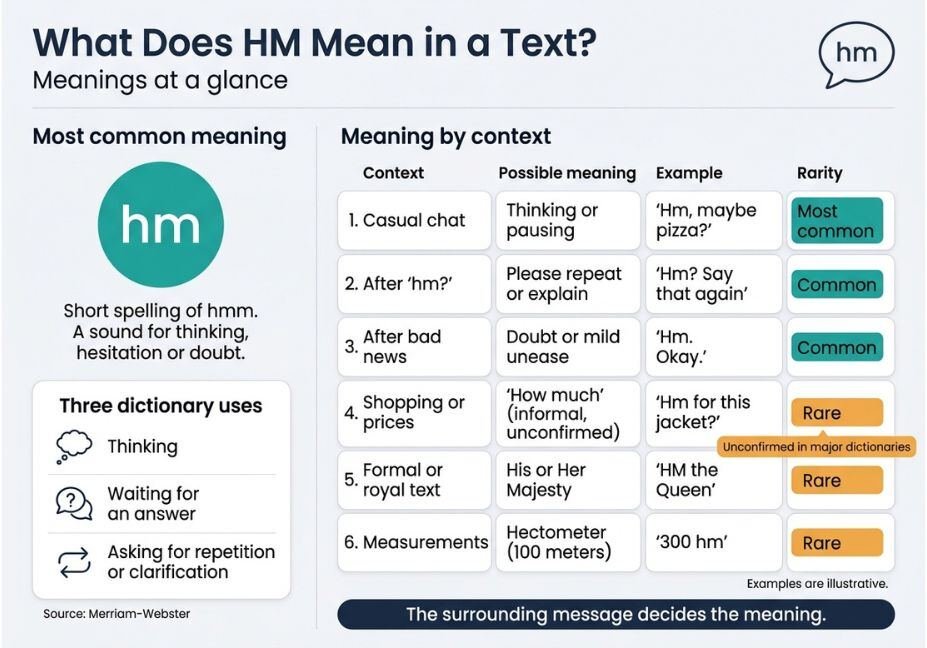
In most messages, “hm” is a short spelling of “hmm,” a sound people make when they think, hesitate or doubt something. Merriam-Webster lists “hm” as a less common spelling of “hmm.” It also lists three uses: showing that someone is thinking, showing that a question is waiting for an answer and asking someone to repeat or explain something.
The tone depends on the message around it. A short “hm” can be friendly, neutral or a little cold, so the chat history matters more than the letters.
HM Meanings at a Glance
The first row is the best supported meaning. The other rows are less common, and the examples are illustrative, not real messages.
| Context | Possible meaning | Example | How to tell |
|---|---|---|---|
| Casual chat | Thinking or pausing | “Hm, maybe pizza?” | A plan or question comes next |
| After “hm?” | Please repeat or explain | “Hm? Say that again” | A question mark ends it |
| After bad news | Doubt or mild unease | “Hm. Okay.” | Short reply after a long message |
| Shopping or prices | “How much” (informal) | “Hm for this jacket?” | The chat is about cost |
| Formal or royal text | His or Her Majesty | “HM the Queen” | Capital letters and a royal subject |
| Measurements | Hectometer | “300 hm” | A number comes before it |
How People Use “HM” in Texting
Most people type “hm” because speech has tone and text does not. A spoken “hmm” can sound curious, doubtful or amused. In a text, the reader has to guess.
Dictionary.com describes “hmm” as an interjection used for reflection, suspicion and requests for clarification. It also notes that the meaning changes with context and intonation. In text, punctuation and the words around it replace that intonation.
When “hm” shows thinking
This is the most common use. The sender needs a moment to decide, remember or look something up.
Example: “Do you want to meet at six?” Reply: “Hm, let me check my schedule.”
When “hm” shows doubt
A short “hm” after a surprising claim can show that the sender is not convinced. It often comes with a follow-up question.
Example: “I finished the whole project last night.” Reply: “Hm. All of it?”
When “hm” asks for more
A question mark turns it into a request. The sender may not have understood you or may want more detail.
Example: “I changed my mind about Friday.” Reply: “Hm?”
How Punctuation Changes the Tone
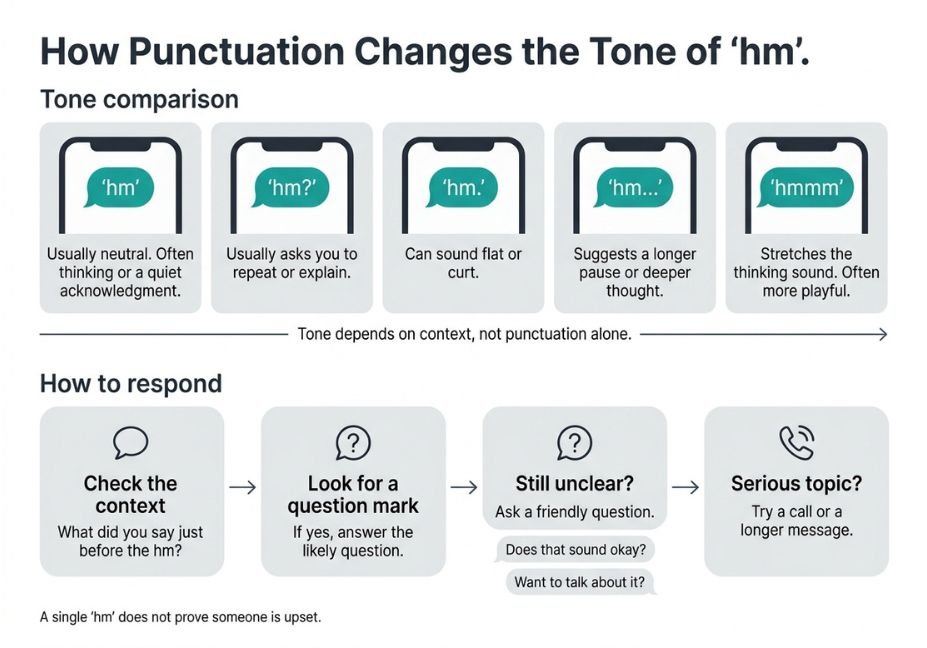
Small marks can shift the feeling of a short reply. Treat these as common patterns, not strict rules.
- hm is usually neutral. It often signals thinking or a quiet acknowledgment.
- hm? usually asks you to repeat or explain.
- hm. can sound flat or curt. Dictionary.com says a curt, low-pitched “hm” can signal dissatisfaction or disagreement in speech, and the same feeling can carry into text.
- hm… suggests a longer pause or deeper thought.
- hmmm stretches the thinking sound and often feels more playful.
A single “hm” does not prove anything about the sender’s mood. Look at how they normally write. If the person usually sends long messages and suddenly sends “hm.” after sensitive news, it may be worth asking how they feel.
Other Possible Meanings of HM
Dictionaries support a few other meanings, but they are rare in everyday texts. Merriam-Webster lists “HM” as an abbreviation for Her Majesty or His Majesty. It also lists “hm” as an abbreviation for hectometer, a unit equal to 100 meters.
Some informal websites say “HM” can mean “high maintenance,” “how much,” “message me” or “honorable mention.” I could not confirm these in a major dictionary, so treat them as possible slang that some groups may use. They are not established meanings. If a friend uses one of them, the surrounding message should make it clear, or you can simply ask.
Common Misunderstandings
- “Hm” always means annoyance. It does not. Many people use it as a simple thinking sound.
- “Hm” is the same as “mm hmm.” They are close but not identical. “Mm hmm” usually shows agreement, while “hm” more often shows thought or doubt.
- A one word reply means someone is angry. Busy, tired or distracted people also send short replies.
- Capital letters always mean an abbreviation. Some people type in capitals out of habit, so “HM” can still be a plain thinking sound.
How to Respond to “HM”
Start by checking the context. Ask yourself what you said just before the “hm.” If you shared an idea or a plan, the sender is probably thinking it over.
If the meaning stays unclear, a short and friendly question works best. You could write, “Does that sound okay?” or “Want to talk about it?” These replies invite the person to explain without making them feel judged.
If the “hm” came with a question mark, answer the likely question. Repeat your point in simpler words or add the missing detail. If you suspect upset feelings, try a call or a longer message, because tone is easier to read when you hear a voice.
Conclusion
In most texts, “hm” is a short thinking sound, much like “hmm.” It can show that someone is pausing to decide, doubting a claim or asking you to explain more. Punctuation and the earlier messages shape its tone, so a plain “hm” feels neutral while “hm.” can feel flat or curt.
Rare meanings such as Her Majesty or hectometer appear only in specific contexts, like royal news or measurements. Other claimed meanings, such as “how much” or “high maintenance,” come from informal sources and should be treated as possibilities. A single “hm” is never proof that someone is upset.
When you cannot tell what someone means, do not guess or assume the worst. A friendly follow-up question, such as “Does that sound okay?” or “Want to talk about it?” is better than silence. If the topic is serious, a quick call can also clear up the tone in seconds. Remember that the surrounding message decides the meaning, not the two letters alone.
FAQs About HM in Text
Is “hm” rude?
Not by itself. In most chats it is only a short thinking sound, and the sender may need a moment to decide or reply. It can feel cold after serious news or a long message, especially when it ends with a period, so check the tone of the whole conversation before you assume the worst.
What is the difference between “hm” and “hmm”?
They carry the same basic meaning. “Hm” is the shorter spelling, and “hmm” is the more common form. Texters often add extra letters, as in “hmmm,” to show a longer pause or a more playful tone.
Does “hm” mean yes or no?
Neither. It usually shows thought or hesitation, so the sender has not made up their mind yet. Wait for the next message or ask a clear yes or no question if you need a firm answer.
Can “hm” mean “how much”?
Some informal sites say so, but I could not confirm it in a major dictionary. It would only make sense in a chat about prices or costs. In nearly every other situation, “hm” is the thinking sound.


3 Comments