Reply of Take Care of Yourself: Best Responses for Any Chat
Someone says “take care of yourself” at the end of a call, a text or a visit. You want to answer in a way that sounds warm and natural. The right reply of take care of yourself depends on who is speaking and why.
This article shows simple replies you can use in texts, at work and with loved ones. You will also see what the phrase usually means, which replies to avoid and how to match your tone to the moment.
Quick Answer
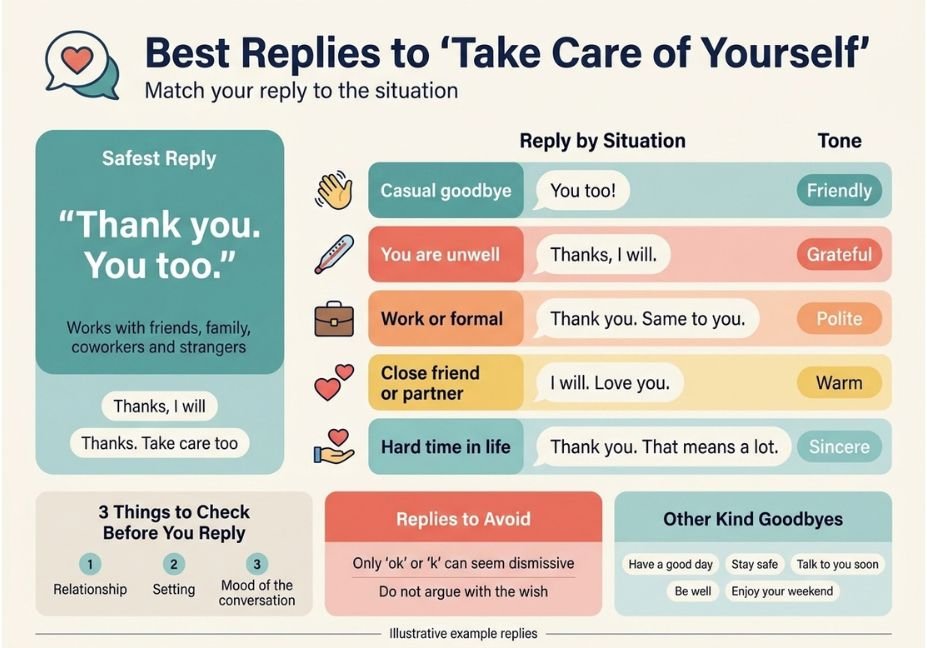
The safest reply is “Thank you. You too.” It works with friends, family, coworkers and strangers. Other good options are “Thanks, I will” and “Thanks. Take care too.”
The phrase is a kind goodbye wish. In most cases it simply means the speaker cares about your wellbeing. The tone of the message can shift this meaning slightly, so read the situation before you answer.
Best Replies to “Take Care of Yourself” by Situation
The table below matches common situations to fitting replies. The messages are examples you can adapt, not fixed rules.
| Situation | Good reply | Example | Tone |
|---|---|---|---|
| Casual goodbye | You too | “Take care of yourself!” “You too!” | Friendly |
| You are unwell | Thanks, I will | “Rest well and take care of yourself.” “Thanks, I will.” | Grateful |
| Work or formal | Thank you, same to you | “Please take care of yourself.” “Thank you. Same to you.” | Polite |
| Close friend or partner | I will. Love you | “Take care of yourself, okay?” “I will. Love you.” | Warm |
| Hard time in life | Thank you, that means a lot | “Be sure to take care of yourself.” “Thank you. That means a lot.” | Sincere |
What “Take Care of Yourself” Usually Means
People say this phrase to show kindness. It tells the listener that the speaker hopes they stay safe, healthy and well. It often appears at the end of a conversation, much like “goodbye” with extra warmth.
The phrase does not usually need a long answer. A short and friendly reply is enough in most cases. Matching the speaker’s energy is a good rule to follow.
When It Means a Simple Goodbye
In casual talk, the phrase closes a conversation. A friend may say it after a short chat or a quick message. A brief reply such as “You too” fits well here.
When It Shows Real Concern
Sometimes the speaker knows you are tired, sick or stressed. Then the phrase carries real care. A warmer answer such as “Thank you, I really needed that” fits better.
When It Might Sound Distant
Rarely, the phrase can feel cold if it follows bad news or a conflict. Context matters in these cases. Look at the earlier messages and the speaker’s usual style before you decide how to respond.
Simple Replies You Can Use Right Now
These replies work in most chats. Pick the one that fits your relationship with the person.
Short and Neutral Replies
- You too
- Thanks, you too💗
- Thank you, I will
- Same to you
These are safe for almost any person. They are brief and polite.
Warm and Friendly Replies
- Thanks, that is sweet of you
- I will. You take care too
- Thank you. I hope you have a great week
- I appreciate that. Talk soon
Use these with friends, relatives and coworkers you know well.
Replies for Texts and Chat Apps
Text messages often call for shorter answers. You can use a quick reply with an emoji if it suits your style.
- “You too! 😊”
- “Will do, thanks!”
- “Thank you, take care!”
An emoji is optional. Skip it in formal or work chats.
Replies for Work and Formal Settings
Professional settings call for a calm and respectful tone. Keep the answer short.
- “Thank you. I appreciate it.”
- “Thank you. Please take care as well.”
- “Thanks for your kind words. Have a good evening.”
Replies When You Are Sick or Stressed
Honesty helps here. You can thank the person and share how you feel.
- “Thank you. I am resting and feeling a bit better.”
- “I will try. It has been a tough week.”
- “Thanks for checking on me. It means a lot.”
How to Choose the Right Reply
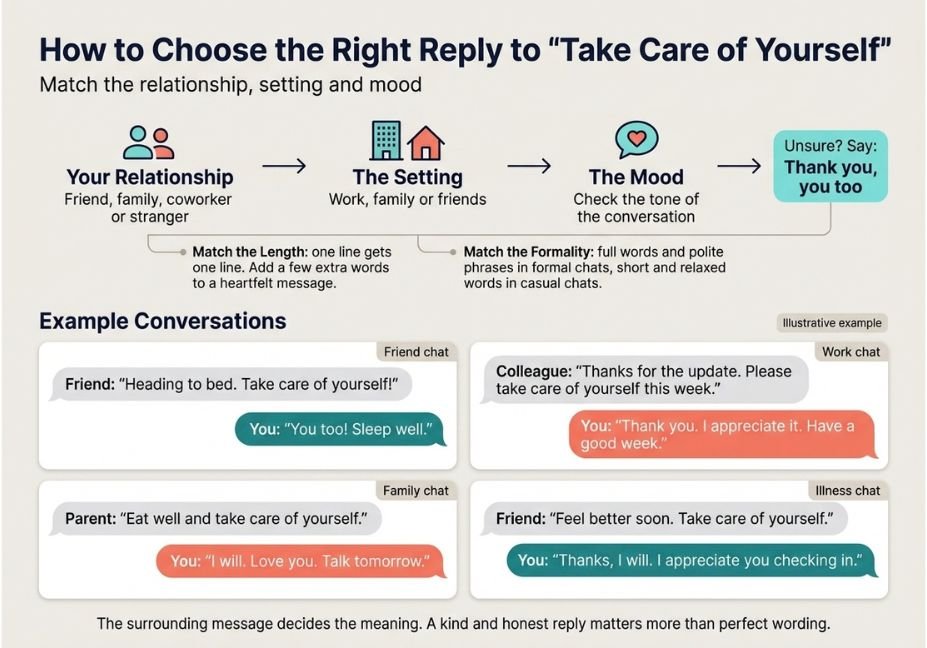
Think about three things before you respond. First, consider your relationship with the person. Second, notice the setting, such as work, family or friends. Third, check the mood of the conversation.
A close friend may enjoy a playful answer such as “Always do!” A manager or client may prefer “Thank you. You as well.” If you are unsure, the simple “Thank you, you too” never fails.
Match the Length of the Message
If the person writes one line, answer with one line. A long reply to a short goodbye can feel awkward. A short reply to a heartfelt message can feel cold, so add a few extra words in that case.
Match the Level of Formality
Use full words and polite phrases in formal chats. Use short and relaxed words in casual chats. Following the speaker’s style helps your reply feel natural.
Replies to Avoid
Some answers can confuse the speaker or sound unkind. Avoid replying with only “ok” or “k” if the person was sincere. It can seem dismissive.
Try not to argue with the wish. Answers such as “I do not need that” may hurt someone who meant well. If you feel uncomfortable, a polite “Thanks” is still better than silence.
Can You Reply Without Repeating the Phrase?
Yes, you can. You do not need to say “take care of yourself” back. Other kind goodbyes work just as well.
- “Have a good day”🤩
- “Stay safe”🙌
- “Talk to you soon”🥰
- “Be well”👍
- “Enjoy your weekend”💖
Choose one that fits the time and the setting. For example, “Enjoy your weekend” suits a Friday message.
Examples of Full Conversations
These sample chats show how replies work in real messages. They are illustrative examples only.
Friend chat
Friend: “Heading to bed. Take care of yourself!”
You: “You too! Sleep well.”
Work chat
Colleague: “Thanks for the update. Please take care of yourself this week.”
You: “Thank you. I appreciate it. Have a good week.”
Family chat
Parent: “Eat well and take care of yourself.”
You: “I will. Love you. Talk tomorrow.”
Illness chat
Friend: “Feel better soon. Take care of yourself.”
You: “Thanks, I will. I appreciate you checking in.”
Conclusion
A good reply of take care of yourself is short, kind and matched to the situation. “Thank you, you too” works almost everywhere. It is polite, easy to remember and safe with friends, family, coworkers and strangers.
You can add more warmth when the moment calls for it. With loved ones, a reply such as “I will. Love you” feels personal and caring. At work, a calm “Thank you. You as well” keeps the tone professional. If you are going through a hard time, an honest answer such as “Thanks, that means a lot” can bring you closer to the person who cares.
Most of all, a kind and honest reply matters more than perfect wording. Even a quick “Thanks” shows that you noticed the care behind the message.
Frequently Asked Questions
What is the best reply to “take care of yourself”?
“Thank you, you too” is the best all purpose reply. It is polite, short and natural. It fits friends, family, coworkers and even strangers. If you want more warmth, you can say “Thanks, I will. You take care too.” Pick the version that matches your bond with the speaker and the setting of the chat.
Is it rude to not reply to “take care of yourself”?
Not always. In a quick chat or a busy group thread, silence is usually fine because the phrase often works as a closing line. However, a brief thanks is kinder when the message feels personal or sincere. This is especially true if the sender knows you are sick or stressed. A short “Thanks” takes only a second and shows you noticed the care.
What does “take care of yourself” mean in a text?
It is a caring goodbye. The sender hopes you stay healthy, safe and well. In a casual chat, it often works like a warm “bye.” After a difficult week or bad news, it can carry real concern. The meaning depends on context, so look at the earlier messages and the sender’s usual tone before you answer.
How do I reply to “take care of yourself” at work?
Say “Thank you. You as well.” This keeps the tone calm and respectful. You can add “Have a good evening” or “Have a good week” if it fits the time of day. Skip emojis and slang in formal chats with managers or clients. A short and polite answer is enough in most workplace settings.
Can I reply with “same to you”?
Yes. “Same to you” is polite and works in most settings. It sounds slightly more formal than “you too,” so it suits work chats and conversations with people you do not know well. With close friends, “you too” or “always do” may feel more relaxed. Both replies return the kind wish without sounding cold.