Absence or Absense: Correct Spelling, Meaning and Examples
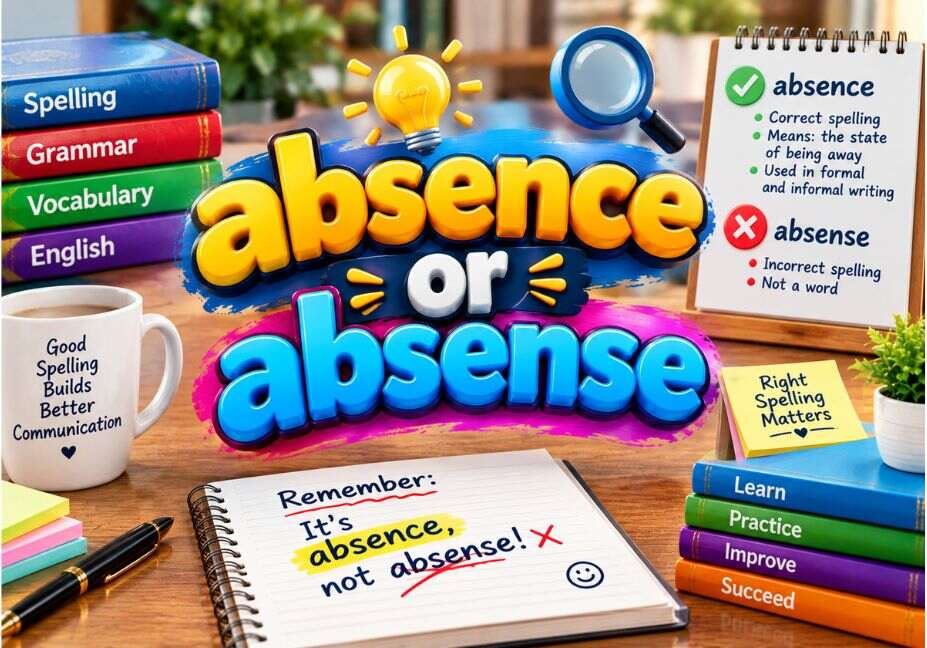
Absence or absense: which one is right? The correct spelling is absence, with “ence” at the end. “Absense” is a common misspelling, and it does not appear as a standard form in the dictionary entry I checked.
This article explains what absence means and how to use it in a sentence. It also shows an easy way to remember the spelling and clears up how absence differs from absent.
Absence vs absense at a glance
| Word | Status | Example (illustrative) | How to tell |
|---|---|---|---|
| absence | Correct noun | “Her absence surprised us.” | Ends in “ence” |
| absense | Misspelling | Not used in correct writing | Ends in “ense” |
| absent | Adjective, verb or preposition | “He was absent today.” | Ends in “ent” |
The examples in this table are written for illustration. They are not quotes from a source.

What does absence mean?
Absence is a noun. It names the state of not being at a place where someone is usually expected, and it can also mean a lack of something.
Absence as not being present
This is the sense most people use. It describes a person who is missing from school, work or an event.
- “Her absence from class lasted a week.” (example)
- “The team started the meeting in his absence.” (example)
You can also use it for a long gap in time. “After a long absence, she came back to the office” is a natural sentence.
Absence as a lack of something
The second sense has nothing to do with people. It describes the lack of a quality, object or feature.
- “The report shows an absence of clear data.” (example)
- “The room felt strange in the absence of sound.” (example)
In this sense, absence works like “lack.” The phrase “absence of” often follows it.
Common phrases with absence
Some phrases come up often in writing. Each one uses the same correct spelling.
In the absence of means “without.” The dictionary gives the example of progress being slow without reform. You might say, “In the absence of a map, we asked for directions.
Absence of mind describes a lapse in attention. The dictionary notes that this sense usually appears in this exact phrase. People may say it when someone forgets a simple task. merriam-webster
Conspicuous by their absence means that people or things were missing in a way that everyone noticed. You might use it when a key guest does not show up.
Leave of absence is a common phrase for approved time away from work or study. Check your own organization’s rules, because policies vary.
How to spell absence correctly
Many English nouns end in “ence.” Think of presence, essence and silence. If you can link absence to presence, the spelling becomes easier to recall. The two words are opposites, and they share the same ending.
Another tip is to split the word into two parts. Say “ab” and “sence” while you write it. The “c” in the middle is the part most writers get wrong. Writers often swap it for an “s” because the sound is the same.
A third tip is to watch for the word “sense.” “Sense” is a real word, but it is not part of absence. The ending is “ence,” so the letters “nse” never appear.
Absence vs absent: what is the difference?
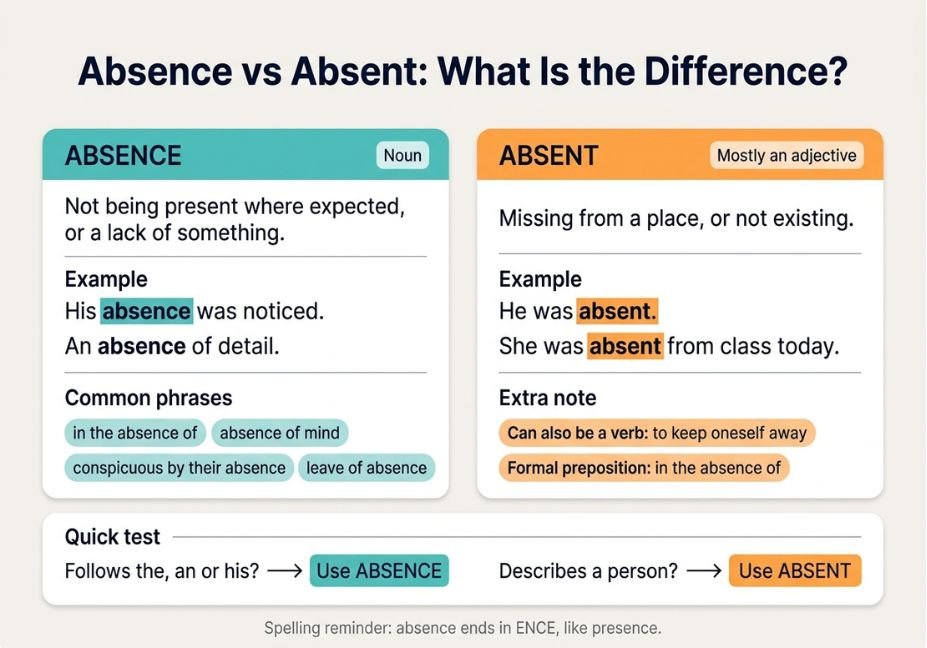
The two words come from the same family, but they play different roles. Absence is a noun. Absent is mainly an adjective.
As an adjective, absent means not present at a usual or expected place, or not existing. You would say, “She was absent from class today.” You would not say, “She had an absent from class.”
Absent can also act as a verb that means to keep oneself away, and as a formal preposition that means “in the absence of.” The verb form is less common in daily speech. The preposition appears mostly in formal writing, for example, “Absent any objections, we will proceed.
Here is a quick test. If the word follows “the,” “an” or “his,” you probably need the noun. If it describes a person, you probably need the adjective.
- “His absence was noticed.” (noun)
- “He was absent.” (adjective)
Common mistakes with absence
Writers tend to make three mistakes with this word.
The first is the spelling error “absense.” Spell-check usually catches it, but not always when you type fast.
The second is mixing up the noun and the adjective. A sentence such as “The absent of the manager was clear” should read “The absence of the manager was clear.”
The third is using “absence” where “lack” would be simpler. Both are correct, but absence often sounds more formal. In casual writing, “lack” can be the better choice.
Should you ever use “absense”?
No. The standard spelling is absence, so “absense” will look like an error to most readers. This matters in school work, emails, job applications and any writing that others will judge.
I found no evidence that “absense” is an accepted variant in the source I checked. If you see it in a text, treat it as a typo.
Conclusion
The spelling you need is absence. Keep the “ence” ending, and link the word to presence if you want a quick memory aid. Both words end the same way, and they are opposites in meaning.
Use absence when you mean a missing person or a lack of something. For example, you might write about an absence from class or an absence of clear data. Use absent when you need an adjective, as in “She was absent today.”
Spell-check can miss “absense” when you type fast, so read your final draft once more. This matters most in school work, emails and job applications, where a spelling error can distract the reader. If you remember one rule, remember that the word never contains the letters “nse” at the end.
Absence or absense FAQs
Is it absence or absense?
The correct spelling is absence. “Absense” is a misspelling and does not appear as a standard form in the dictionary entry I checked.
The word ends in “ence,” like presence and essence. If you link it to presence, the right spelling is easier to recall.
What does absence mean?
Absence means not being present where you are expected. It can also mean a lack of something.
You can speak of an absence from work or an absence of detail. The first describes a missing person, and the second describes something that is missing from a text or a plan.
What is the difference between absence and absent?
Absence is a noun, and absent is mostly an adjective. Absent describes someone who is missing or something that does not exist.
“His absence was noticed” uses the noun. “He was absent” uses the adjective.
How do you pronounce absence?
Absence has two syllables, and the stress falls on the first one. It sounds like AB-suhns.
The second syllable sounds like “sense.” This sound is one reason people mistakenly write “absense.”


One Comment