
Writing or Writting? The Correct Spelling and Why It Matters
Writing or writting: which one is right? If you just stopped mid sentence to check, you are not alone. Millions of people type both spellings into Google every year. The answer is quick, and the reason behind it will help you spell hundreds of other words too.
In this guide you will learn which spelling is correct and why the other one looks right but is not. You will also see where the word came from, why the mistake is so common, and a few simple tricks to lock in the right spelling for good. Let us start with the short answer.
Quick Answer: Writing or Writting?
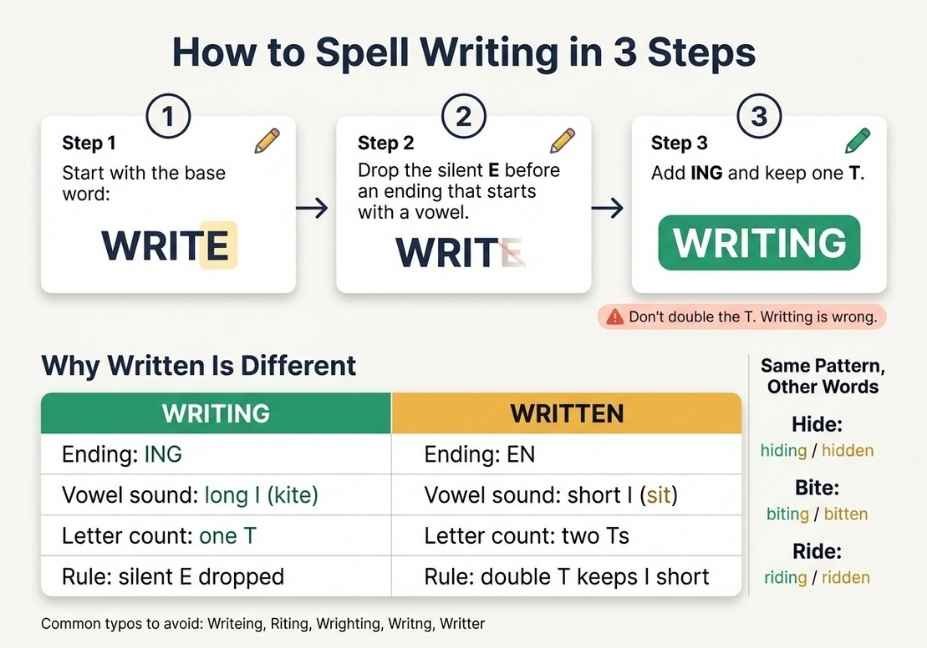
Writing is the correct spelling. It has one T. Writting is a common misspelling and is not a word in any standard English dictionary. You add ING to the base word write after dropping the silent E. That gives you writing.
Why Writing Is the Correct Spelling
The spelling comes down to one clear rule. Once you see it, the confusion goes away.
The Silent E Rule
The base word is write. It ends in a silent E. When you add an ending that starts with a vowel, you drop that E. ING starts with a vowel, so the E goes away.
Here is how that looks with other words:
- Write becomes writing.
- Bite becomes biting.
- Hide becomes hiding.
- Ride becomes riding.
- Make becomes making.
None of these words doubles its middle consonant. They all keep one letter and lose the E. Writing follows the same path.
Merriam-Webster lists writing as the only standard spelling of the word. The Oxford English Dictionary does the same. Neither one recognizes writting as a valid form.
Writing vs Written
Here is where most of the trouble starts. The word written does have a double T. So many people think writing should have one too.
But these two words are built in different ways. Written is the past participle of write. It uses the ending EN. The double T in written helps keep the I short. Say it out loud. The I in written sounds like the I in sit.
The I in writing is long. It sounds like the I in kite. A single T keeps it long. Think of the pair this way:
- Writing has a long I and one T.
- Written has a short I and two Ts.
The same pattern shows up in other word pairs. Hide gives you hiding and hidden. Bite gives you biting and bitten. Ride gives you riding and ridden. The short vowel forms get the double letter. The long vowel forms do not.
Where the Word Writing Comes From
The word write has a long history. According to the Online Etymology Dictionary, it comes from the Old English word writan. That word meant to score or outline or draw. Early writers did not use pens. They scratched marks into wood and stone and bone.
The idea of making marks is still inside the word today. It is also tied to old Germanic words with a similar meaning. Over time the meaning shifted from scratching a surface to forming letters and words.
The ING ending is also very old. English uses it to turn a verb into a noun or a describing word. So writing can mean the act of writing. It can also mean the finished text itself. A letter or a story or an essay can all be called a piece of writing.
You may also see the word wright in words like playwright and shipwright. This is a different word with a different root. It comes from an old term for a worker or maker. It sounds like write but it is not the same thing. A playwright is a person who makes plays. That is why the spelling is odd.
Why People Type Writting
Spelling mistakes are not random. Most of them follow a pattern. Here are the main reasons people write writting.
Confusion With Written
This is the biggest cause. The word written is very common. Your eyes see the double T often. Your brain stores that shape. When you go to spell writing the double T slips in.
Fast Typing and Autocorrect
Many typos happen when your fingers move faster than your brain. Hitting the same key twice is easy. Phones and laptops fix many errors on their own. But autocorrect does not catch everything. Sometimes it misses a word it does not expect. And sometimes people turn it off.
Sound and Pattern Mistakes
English has many words where a short vowel is followed by a double letter. Think of sitting and hitting and running. People learn that pattern early. Then they apply it to words where it does not belong. Writing has a long vowel sound. So it follows a different rule.
Some learners also spell by sound alone. They hear a quick, sharp T in the middle of the word. They think a double T must be there. It is not.
Other Common Misspellings of Writing
Writting is not the only mistake. People also type these forms:
- Writeing keeps the silent E when it should be dropped.
- Riting leaves out the W.
- Wrighting mixes the word with wright.
- Writng drops the I by accident.
- Writing with a capital I in the middle looks odd and is just a typo.
The related word writer also gets hit. Many people type writter with a double T. The right spelling is writer with one T. The same rule applies. Write plus ER gives you writer. You drop the E first.
Here are the right and wrong versions side by side:
- Writer is correct. Writter is wrong.
- Writing is correct. Writting is wrong.
- Writes is correct. Writtes is wrong.
- Written is correct. Writen is wrong.
Notice that written is the only one that needs two Ts.
Easy Tricks to Remember the Right Spelling
Rules are great but memory tricks make them stick. Try one of these.
- Say the I out loud. A long I means one T.
- Match writing with biting. Neither one has a double letter.
- Remember that only written gets two Ts.
- Picture the E falling off write before ING lands.
- Link writing to riding. Both lose the E and keep one consonant.
You can also build a small mental checklist. Ask yourself two questions. Is the word ending in ING? If yes then drop the silent E and check the vowel sound. Is the vowel long? If yes then do not double the letter.
Another helpful habit is to read your work out loud. Your eyes can skip a typo but your ears often catch it. Reading backward one word at a time also helps. It forces you to look at each word alone.
The Forms of Write at a Glance
It helps to see every form of the word together. Here they are in one place:
- Write is the base form.
- Writes is the third person form.
- Wrote is the past tense.
- Written is the past participle.
- Writing is the present participle and the noun form.
- Writer is the person who writes.
Only one of these has a double T. That is written. Every other form has a single T. If you remember that one fact you will rarely make this mistake again.
Writing in Real Sentences
Seeing a word in use makes the spelling feel natural. Here are some simple examples.
- Her writing is clear and easy to follow.
- I spend an hour writing every morning.
- The teacher praised his writing on the test.
- Writing a good email takes practice.
- She is writing a book about her childhood.
Now see how the sentence looks when the word is wrong. “Her writting is clear” looks off even if you cannot say why. Readers notice. A single typo can pull their eyes away from your message.
Does the Spelling Change in British or American English?
No. Both versions of English use the same spelling. Writing has one T in the United States and in the United Kingdom. It is also the same in Canada and Australia. Some words do change between regions. Think of color and colour. But this word stays the same everywhere.
So you never need to worry about which country your reader lives in. Writing with one T is always safe.
Why Spelling Matters in Your Work
You might wonder if one extra letter is a big deal. In casual texts it rarely is. Your friends will know what you mean. But in other settings the stakes are higher.
A resume with a spelling error can hurt your chances of getting an interview. A school paper with typos may lose points. A business email with a mistake can make your company look careless. Readers often judge your skill by how clean your text is.
Search engines care about this too. If you run a blog or a website the way you spell your keywords matters. People do search for misspelled words. But your content should use the correct forms. That builds trust with readers and with search tools.
The good news is that this is an easy fix. Once you know the rule you can spot the error in seconds. A quick scan before you hit send is often enough.

Tips for Better Spelling Overall
If you want to improve more than just this one word here are a few habits that help.
- Keep a short list of words you often miss.
- Use a spell checker but do not trust it blindly.
- Read more. Seeing words often builds memory.
- Learn a few core rules like the silent E rule.
- Practice with short writing drills each day.
Spelling is a skill and it grows with use. Even skilled authors rely on editors and tools. There is no shame in checking a word. The goal is to build good habits so you check less over time.
Conclusion
Writing is the only correct spelling. It has one T and follows the silent E rule. You take write and drop the E and add ING. That is the whole process. Writting looks right to many people because the word written has two Ts. But that double letter belongs to a different word with a different ending and a different vowel sound.
Keep these takeaways close. Writing has a long I and one T. Written has a short I and two Ts. Writer has one T as well. If you ever feel unsure say the word out loud and compare it to biting or riding. That small check will save you from the most common mistake. With the rule in hand you can write with confidence in emails and essays and posts.
FAQs About Writing or Writting
Is writting a real word?
No. Writting is a misspelling. It does not appear in standard dictionaries. The correct spelling is writing with one T.
Why does written have two Ts but writing has one?
Written uses the EN ending and keeps the I short. Writing uses ING and keeps the I long. The double T only signals the short sound.
How do you spell the person who writes?
The word is writer with one T. You drop the silent E from write and add ER. Writter is a common error.
Is writting acceptable in British English?
No. British and American English both use writing. Writting is wrong in every region and in every kind of formal or casual text.
What is a quick way to remember the spelling?
Compare writing with biting. Both lose the silent E and keep one consonant. Only written needs a double T.




One Comment