Suing or Sueing: Which Spelling Is Correct? (Quick Answer)
You are writing an email or a social post and you freeze. Is it suing or sueing? Both look fine on the screen. Only one is right. Spell check may catch the error. Autocorrect may not. The doubt is real because English spelling rules do not always feel logical.
This guide gives you the answer first. Then it shows you why. You will learn the rule behind the word and the exceptions that confuse people. You will also see the meaning and the origin of the word. Plenty of examples are included so you can copy the right form with confidence.
Quick Answer: Suing or Sueing?
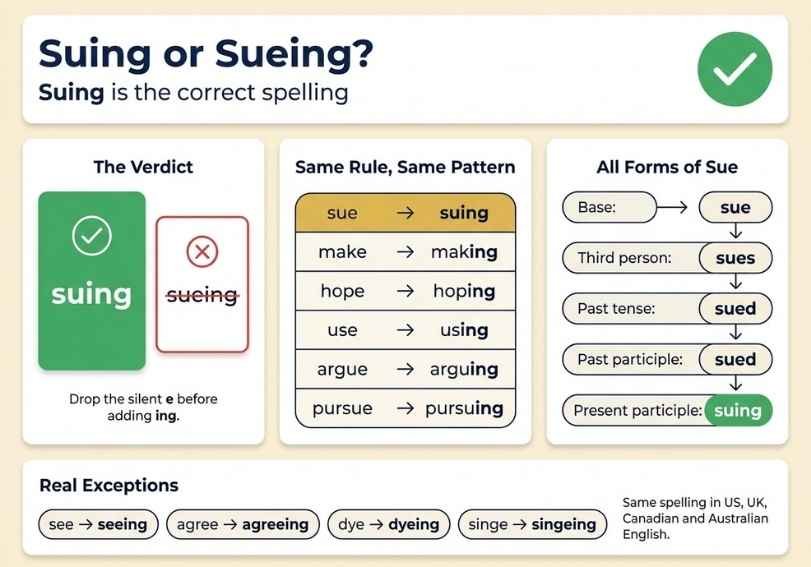
Suing is the correct spelling. It is the present participle of the verb “sue.” You drop the silent e before adding ing. “Sueing” is a common misspelling and is not listed as a standard form in major dictionaries.
Example: “She is suing her landlord for the unpaid deposit.”
Why Suing Is the Correct Spelling
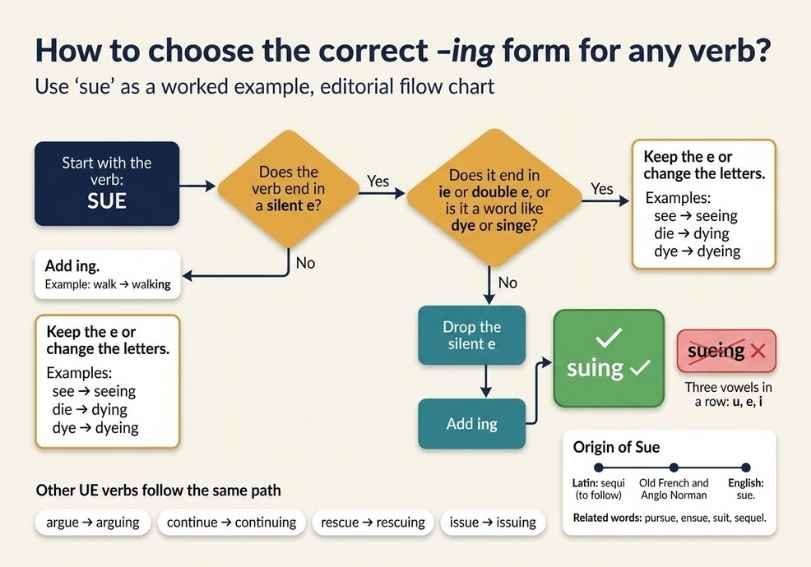
The verb is sue. It ends in a silent e. That e makes no sound of its own. English has a clear rule for this case. When a verb ends in a silent e you drop the e before adding ing. You already follow this rule with many words:
- make becomes making
- hope becomes hoping
- use becomes using
- argue becomes arguing
- sue becomes suing
Sue follows the same pattern. No special rule is needed. According to the Cambridge Dictionary the forms of this verb are sue and sues plus sued and suing. The spelling “sueing” does not appear there.
The Three Vowel Problem
Look at “sueing” for a moment. It stacks three vowels in a row. You get u and e and i side by side. English rarely likes that. Your eye may flag the word as odd even if you cannot say why. That small feeling of “this looks wrong” is a good clue. Trust it.
Why So Many People Write Sueing
The mistake is easy to make. Several things push people toward it.
Keeping the e feels safe. Some verbs do keep the e before ing. People remember those and apply the pattern everywhere. Here are the common ones:
- see becomes seeing
- agree becomes agreeing
- flee becomes fleeing
- dye becomes dyeing
- singe becomes singeing
These are real exceptions with real reasons. Verbs that end in double e keep both letters. Dye keeps its e so it does not turn into “dying.” Singe keeps its e so it does not turn into “singing.” Sue has no such problem. Nobody mixes up “suing” with another word.
The word queue adds confusion. Many dictionaries list both queuing and queueing. The form “queueing” is famous because it holds five vowels in a row. People see that spelling and assume other ue verbs can do the same. They cannot. Queue is a rare case with a settled alternate form.
Fast typing hides errors. Most people type sue and then add ing without thinking. The finger memory keeps the e. Your brain reads what it expects instead of what is on the page.
Rules are taught once and then forgotten. Most of us learned the silent e rule in early school. We rarely think about it as adults. A word like suing comes up so seldom that we have no practice with it.
Verbs That End in UE Follow the Same Rule
Sue is not alone. Many verbs end in ue. Nearly all of them drop the e before ing. This table of examples shows the pattern clearly:
- argue becomes arguing
- continue becomes continuing
- pursue becomes pursuing
- rescue becomes rescuing
- ensue becomes ensuing
- glue becomes gluing
- issue becomes issuing
- subdue becomes subduing
- value becomes valuing
Now ask yourself a simple question. Would you ever write “continueing” or “arguening”? Probably not. Both look wrong right away. Sueing is wrong for the same reason.
The only real wobble is the verb cue. Some writers use cuing and others use cueing. Both appear in print. Sue has no such split.
Other ING Rules That Help You Spell Better
Knowing the wider rules makes you faster and more accurate. Here are the main ones in plain words.
Drop the silent e. This is the rule that gives us suing. Examples include write and writing or bake and baking.
Change ie to y. Verbs that end in ie change those letters to y. Die becomes dying. Lie becomes lying. Tie becomes tying.
Double the final consonant. Short verbs with one vowel and one final consonant often double that consonant. Run becomes running. Stop becomes stopping. Sit becomes sitting.
Add ing with no change. Most verbs just take ing. Walk becomes walking. Talk becomes talking. Verbs that end in y also stay the same. Try becomes trying.
Sue belongs to the first group. That is the whole story.
All the Verb Forms of Sue
Here is the full set so you can check any sentence:
- Base form: sue
- Third person singular: sues
- Past tense: sued
- Past participle: sued
- Present participle: suing
Notice that the past tense sued just adds d. The verb already ends in e so you do not add another one. People sometimes write “sueed” or “sude.” Both are wrong.
Use suing when the action is in progress. Use sued when it is finished. Use sues when you talk about one person in the present. A few quick pairs show the difference:
- She sues the company every year.
- She sued the company last year.
- She is suing the company right now.
What Does Sue Mean?
In everyday English to sue means to bring a legal case against a person or a group. The goal is usually to get money or to force someone to act or stop acting. The person who files the case is the plaintiff. The person who gets the complaint is the defendant.
You can sue for many reasons. People sue over unpaid bills or broken contracts. They sue after accidents or injuries. Companies sue over stolen ideas or damaged reputations. Each case starts the same way. Someone files a claim and a court decides what happens next.
Suing also has a looser use in casual talk. People joke, “I’m going to sue you for that!” when a friend spoils a movie or eats their snack. Nobody plans a real case. The phrase just adds humor.
This article covers spelling and meaning only. It is not legal advice.
Where the Word Sue Comes From
The Oxford English Dictionary traces sue back to Old French and Anglo Norman roots. Those roots link to the Latin verb sequi. It means “to follow.” The idea is simple. When you sue someone you follow them into court to demand what you think is fair.
That root also gave us other familiar words. Pursue and ensue and suit and sequel all come from the same family. Even the word “lawsuit” holds the same history. It joins law and suit in one compound.
Sue once had a wider meaning. Writers used it to mean asking or begging. You can still hear that sense in the old phrase “sue for peace.” It means to ask an enemy to stop fighting. Modern speakers use the legal meaning far more often.
How to Use Suing in a Sentence
Suing works as a verb form and also as a noun that names the act. Grammar teachers call that second use a gerund. You do not need the label. You only need to see it in action. Here are clean examples you can borrow:
- The tenant is suing the landlord over a broken heater.
- Are you really suing them for a late delivery?
- He talked about suing the company but never did.
- Suing someone costs time and money.
- They are suing for breach of contract.
- Suing in small claims court is often faster.
Each line shows a natural fit. The word follows a form of “to be” in some lines. In others it acts like a subject. Either way the spelling stays the same.
Words and Phrases Linked to Suing
Knowing nearby terms helps you read and write about the topic with ease. These are the most common ones:
- Lawsuit: the legal case itself
- Plaintiff: the person who starts the case
- Defendant: the person who is sued
- Countersue: to sue someone who has sued you
- Litigation: the whole process of taking a dispute to court
- Sue for damages: to ask a court for money
You will also see common phrases built with prepositions. People sue for money or sue over a problem. They sue on behalf of a group or sue to stop an action. News writers often say “threatened to sue” when a case has not started yet.
Notice how often ing shows up with these. “Countersuing” drops the e just like suing does. So does “pursuing” and “issuing.” The pattern repeats everywhere.
Common Misspellings and Mix Ups
Even careful writers slip with this word. Watch for these errors:
- Sueing: the most common mistake, caused by keeping the silent e
- Suiing: a typo that adds an extra i
- Sueed: a wrong past tense form of sue
- Sewing: a different word that means stitching cloth
- Suiting: a form of suit, which has another meaning
Sue and sew are not the same word. They do not sound alike in most accents. Sue rhymes with “do.” Sew rhymes with “go.” Yet some people still confuse them in writing. Keep the legal sense in mind and you will pick the right one.
Does the Spelling Change in British or American English?
No. Suing is the same in American and British English. It is also the same in Canadian and Australian English. This word does not have regional versions like “color” and “colour.” If you see “sueing” in any country it is a mistake.
Why Getting This Spelling Right Matters
A small typo can cost trust. Readers notice errors in a legal email or a business post. A wrong spelling can make your message seem careless. In a legal setting it can even make a document look sloppy to the other side.
Search engines notice too. People often type both spellings into Google. The search tool usually shows results for the correct form. But writing the word right in your own content helps your pages match what people expect to see. Clean spelling signals care and quality.
It also helps your own confidence. Once you know the rule you can stop second guessing. You will spell suing right every time and also spell similar words right.
Easy Ways to Remember the Right Spelling
Try these quick memory tricks:
- Think “using” and then swap the first letters to get “suing”
- Say the rule out loud: drop the silent e
- Notice that three vowels in a row look strange
- Picture the word “pursuing” which people rarely misspell
- Let spell check flag the word and then learn from the fix
Pick the one that feels natural. Repeat it a few times. The habit sticks fast.
Conclusion
The answer to the suing or sueing question is clear. Suing is right and sueing is wrong. The reason is a rule you use every day. A silent e drops away when ing arrives. The same rule gives us using and arguing and pursuing.
The main takeaway is simple. When you see a verb that ends in ue, drop the e and add ing. Do this with sue and you will spell it right every time. Keep the short list of exceptions in mind for words like dye and see. Then write with confidence.
FAQs About Suing or Sueing
Is it suing or sueing?
Suing is correct. Sueing is a misspelling. Drop the silent e from sue before you add ing.
What is the past tense of sue?
The past tense is sued. You only add d because the verb already ends in the letter e.
Why do you drop the e in suing?
English drops a silent e before ing. It matches using and making and arguing. Keeping it would stack three vowels in a row.
Is sueing ever acceptable?
No. Major dictionaries such as Cambridge list suing only. Sueing counts as a spelling error in formal and casual writing.
Does queueing prove sueing is right?
No. Queue is a rare case with an accepted alternate form. Sue follows the normal rule and becomes suing.
Conclusion
The answer to the suing or sueing question is clear. Suing is right and sueing is wrong. The reason is a rule you use every day. A silent e drops away when ing arrives. The same rule gives us using and arguing and pursuing.
The main takeaway is simple. When you see a verb that ends in ue, drop the e and add ing. Do this with sue and you will spell it right every time. Keep the short list of exceptions in mind for words like dye and see. Then write with confidence.