Flying Elephant Memoirs: What the Term Really Refers To
If you typed flying elephant memoirs into Google, you probably expected a book. Maybe you wanted a life story about a pilot, a circus star or an athlete. You are not alone. Many people land on this phrase after a strange link or a search suggestion. Here is the catch. It is not slang, and I could not verify a published memoir with that exact title.
This guide sorts out the confusion. You will learn what the phrase can point to. You will meet the real Flying Elephants of the Royal Air Force. You will also meet a Russian detective novel and a few famous flying elephant stories. Finally you will get a simple checklist for spotting fake memoir pages.
What Does Flying Elephant Memoirs Mean?
Flying elephant memoirs is not a slang term. It is also not a verified published memoir. The phrase most often points to The Flying Elephants, a history of No. 27 Squadron of the Royal Air Force. It can also point to Boris Akunin’s novel The Flying Elephant. Some weak web pages use the phrase too, but they name no real author or publisher.
What Searchers Really Want to Know
The search intent here is mostly informational. People want a meaning or a book title. Some also hope to read or buy the memoir. That adds a light commercial angle. But no verified book sits behind the exact phrase. So the most useful answer is a clear guide that separates real sources from empty ones.
The real question is simple: what is flying elephant memoirs and is it a real book?
People usually type the phrase for one of these reasons:
- They saw it on an odd web page or in a search suggestion.
- They remember a book about flying elephants but forgot the title.
- They know the RAF squadron nickname and want its story.
- They want a children’s book or film about a flying elephant.
Is There a Real Book Called Flying Elephant Memoirs?
I searched the web for the exact phrase. I did not find a trusted publisher page. I did not find a library record or a major bookseller listing either. That does not prove that no small press book exists. It does mean you should be careful. Many results are thin pages with no clear author.
Pages About an Olympic Champion
A few sites carry a page called The Flying Elephant Memoirs of an Olympic Champion. The text on those pages reads oddly. Sentences repeat the title again and again. Some word choices make no sense in plain English. That is a common sign that software rewrote the text.
The pages also leave out basic facts. They give no author name. They give no publisher and no ISBN. They offer no excerpt from a real book. A real memoir would almost always include at least one of those things.
Pages About a Circus Aerialist
Another page describes a circus memoir by an aerialist named Alexander Savin. It talks about elephant handlers and daring flights over Europe. It sounds lively. Yet I could not find a publisher or a release date for it. I could not find a library record either.
That does not make the story impossible. It makes it unverified. Until a real source confirms it, treat it as unproven.
Why This Matters
A real memoir leaves a trail. You can find an ISBN. You can find a publisher. You can find reviews from named readers. Pages that skip all of this ask you to trust them blindly. Do not. Search engines may rank such pages for a while. That does not make them true.
The Real Flying Elephants Behind the Search
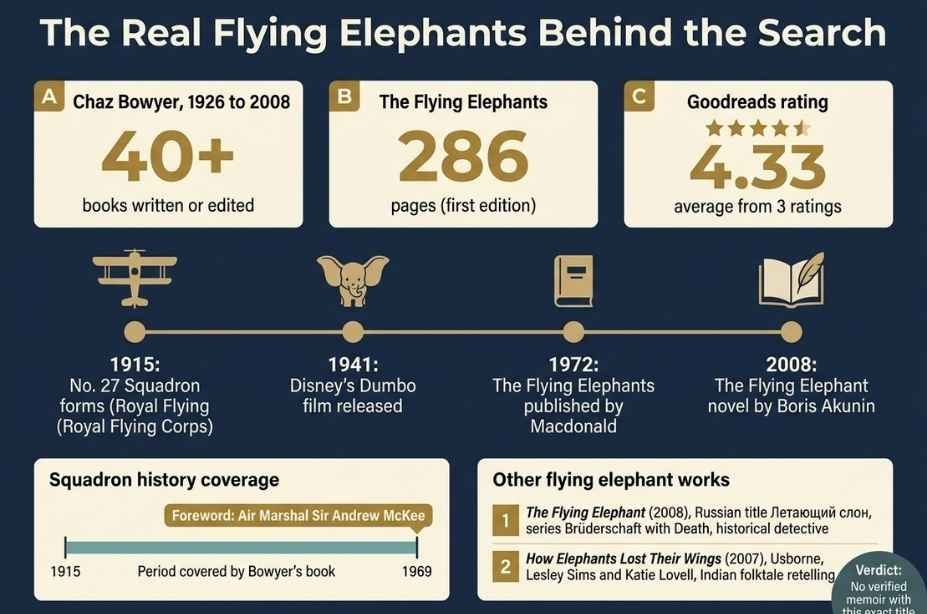
The exact memoir is missing. But the words flying and elephant do point to real works. Four of them stand out.
The RAF Squadron Known as the Flying Elephants
No. 27 Squadron formed in 1915 as part of the Royal Flying Corps. It later became part of the Royal Air Force. People in military history circles call it the Flying Elephants. The nickname is commonly traced to its early aircraft, the Martinsyde Elephant. That plane was big and heavy for its day. The name stuck.
The elephant also became part of the squadron’s identity. Over the decades the unit flew many types of aircraft. Its story runs through two world wars and many years of peacetime service.
So when someone says flying elephant in an aviation setting, they often mean this squadron. A memoir by a former member would fit the phrase well. That may be why the words flying elephant and memoirs sit together in some search results.
Chaz Bowyer and The Flying Elephants
The best known book with this name is The Flying Elephants by Chaz Bowyer. According to Wikipedia, Raymond Chaz Bowyer lived from 1926 to 2008. He worked as an RAF armaments and explosives instructor. After he retired he wrote and edited more than forty books about the Royal Flying Corps, the Royal Air Force and the Royal Naval Air Service.
Wikipedia calls The Flying Elephants his first major work. Macdonald published it in 1972. It covers No. 27 Squadron from 1915 to 1969. Air Marshal Sir Andrew McKee wrote the foreword. Bowyer had served in the unit himself.
This book is a unit history and not a personal memoir. Yet it focuses on the aircraft and the people who flew them. A rare book dealer lists a first edition at 286 pages with black and white photos. Goodreads shows only three ratings with an average of 4.33. That tells you it is a niche title for history fans.
Boris Akunin and The Flying Elephant
Boris Akunin is a bestselling Russian author. Wikipedia describes The Flying Elephant as a novel from 2008. The Russian title is Летающий слон. It belongs to the series Brüderschaft with Death. The genre is historical detective fiction.
The story follows Joseph von Teofels in Russia in early 1915. That was during the First World War. Spies from Russia and Germany play key roles. The plot also centers on a new device that could change the war if Russia could mass produce it.
This book is fiction. It is not a memoir. But a reader who half remembers the title might later call it one. That kind of mix up is common in search.
Folktales and Dumbo
The flying elephant is also a classic image in stories. A library catalog entry for How Elephants Lost Their Wings describes it as an Usborne book from 2007. It retells an Indian folktale in which elephants once could fly. Lesley Sims and Katie Lovell made the book for young readers.
Then there is Dumbo. Disney released the animated film in 1941. It tells of a young circus elephant who flies using his large ears. Many people think of Dumbo first when they hear flying elephant.
None of these works is a memoir. Yet they show why the image feels so familiar. It may also explain why a vague search gets mixed with circus stories.
How to Check Whether a Memoir Is Real
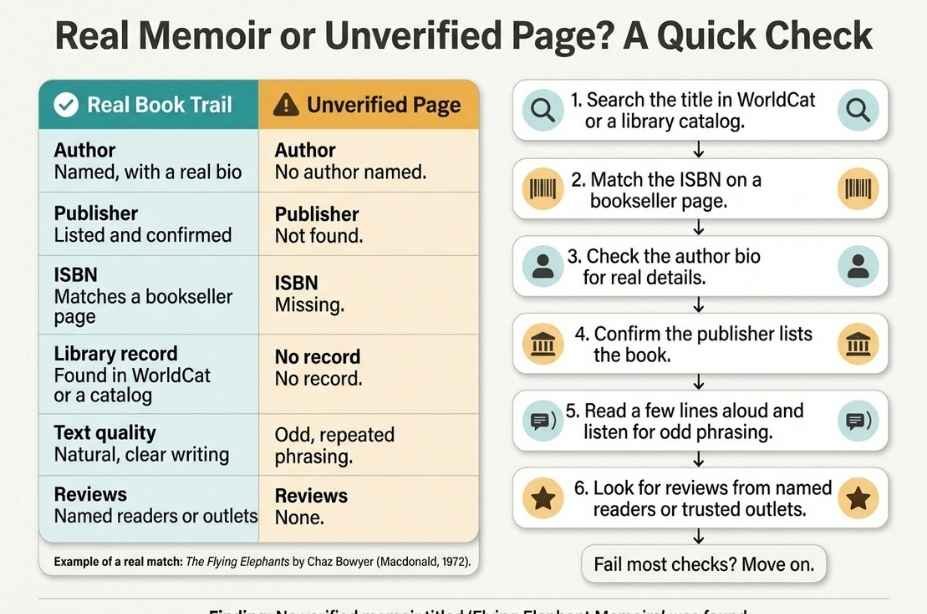
You can test almost any book claim in a few minutes. Use these steps whenever a title looks suspicious:
- Search the title in WorldCat or your local library catalog.
- Look for an ISBN and match it on a bookseller page.
- Check that the author has a bio with real details.
- Find the publisher and confirm it lists the book.
- Read a few lines aloud and listen for odd phrasing.
- Look for reviews from named readers or trusted outlets.
If a page fails most of these checks, move on. Real books are easy to confirm. Fake or unverified ones are not.
Why Strange Keywords Like This Appear
Some sites build pages around phrases that people search. They mix a few real words into a title and fill the page with generic text. Software can write such pages in seconds. The goal is clicks and ad income.
Search suggestions add to the problem. Flying elephant and memoirs are both common words. Placed side by side they look like a real title even when no book exists. One odd page can then feed another. Soon the phrase seems more real than it is.
Search engines work to push this thin content down. Still some pages slip through. That is why it pays to check a source before you trust it. A few minutes of checking can save you from wrong facts.
Better Ways to Search for What You Want
If you want the RAF story, search for No. 27 Squadron history or the Chaz Bowyer book title. If you want fiction, search for Boris Akunin and The Flying Elephant. If you want a child friendly story, try flying elephant picture book or the folktale title.
Adding an author name helps a lot. So does adding a year or a publisher. Quotation marks around a full title narrow the results too. These small steps cut out most of the noise.
If you remember a plot detail, add it to your search. A single detail such as a circus or a war year can lead you to the right book fast.
Conclusion
Flying elephant memoirs is not a slang code and not a confirmed book. It is a phrase built from two common ideas. The real works nearby are a history of an RAF squadron and a Russian spy novel. A few children’s stories and a famous Disney film also share the image.
Your best next step is simple. Decide what you actually want to read. Then search by title and author instead of the vague phrase. Check any memoir claim for an ISBN and a real publisher. If those are missing, keep looking. The truth is usually easy to find once you know where to start.
FAQs About Flying Elephant Memoirs
What Does Flying Elephant Memoirs Mean?
“Flying Elephant Memoirs” is not a widely recognised slang phrase. It may refer to historical writings about the Royal Air Force (RAF), books related to flying elephants, or information found on websites discussing similar titles. The exact meaning depends on the context in which you see the phrase.
Is Flying Elephant Memoirs a Real Book?
I could not verify a published memoir with the exact title Flying Elephant Memoirs. However, books with similar names do exist, which may cause confusion when searching online. One example is The Flying Elephants by Chaz Bowyer, a historical book about an RAF squadron.
Who Wrote The Flying Elephants?
The Flying Elephants was written by Chaz Bowyer and published by Macdonald in 1972. The book covers the history of No. 27 Squadron, a British military aviation unit. It provides historical information about the squadron and its aircraft, making it different from a personal memoir.
Why Is No. 27 Squadron Called the Flying Elephants?
No. 27 Squadron of the Royal Air Force is associated with the nickname “Flying Elephants.” The name is commonly linked to the Martinsyde G.100 and G.102 aircraft, which were known as the Elephant. The nickname became part of the squadron’s historical identity and helped distinguish it from other RAF units.
Who Wrote the Novel The Flying Elephant?
Russian author Boris Akunin wrote The Flying Elephant, a historical detective story published in 2008. The title is similar to The Flying Elephants by Chaz Bowyer, but the two works are different. Bowyer’s book focuses on military aviation history, while Akunin’s work belongs to historical detective fiction.